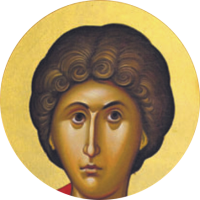
| Today (May 25), the Holy Church commemorates the Third Finding of the Venerable Head of St. John the Baptist and Forerunner of the Lord. It is one of those “curious” commemorations that, unfortunately, goes unnoticed each year by most Orthodox believers. The third discovery of the Head of the Holy Prophet occurred in abut the year 850 A.D. (see the account of the First and Second Discoveries on February 24). The head of Saint John the Forerunner was first found on the Mount of Olives, where it had been hidden by Joanna, wife of Chusa, after the Saint’s martyrdom by beheading; and found the second time in the city of Emesia during a time of unrest at Constantinople connected with the exile of Saint John Chrysostom (November 13). It was transferred to Komana, the former Titular See of Bishop George (Papaioannou) of blessed memory, during the Saracen raids (about 820-820) and it was hidden in the ground during a period of iconoclastic persecution. When the veneration of icons was restored, Patriarch Ignatius (847-857) saw in a vision the place where the head of Saint John the Forerunner was hidden. The patriarch communicated this to the emperor, who sent a delegation to Komana. There the head was found a third time around the year 850. Afterwards the head was again transferred to Constantinople, and there on May 25 it was placed in a church at the court. A segment from the head of the Forerunner is also on Mt. Athos. Why does the Church venerate relics (Greek, “leipsana”)? Of what possible meaning could they be to Orthodox believers standing on the cusp of, as the British author Aldous Huxley wrote, “a brave new world?” Our holy father St. Silouan of Mt. Athos explains in simple terms: “Holy Relics are the earthly remains of those who have been taught by none other than Christ Himself to love their enemies even unto death, the death of the Cross, which is His glory, and which by grace becomes their glory too. Love for enemies is not a moral injunction, it is the fundamental criterion for the Christian way of life. This is Salvation.” For St. Silouan, relics are “touchstones” not simply to the life of the holy one whose relic it is, but to God’s love, a connection to the very essence of God. Being in His nature pure Love, relics become holy reminders, arrows pointing the way, gifts of grace from the Incarnate God who gave Himself, not only as High Priest but as Victim. In T.L.Fraziers booklet, Holy Relics (Conciliar Press, 1997), we learn that the Scriptures are full of God’s Divine Grace working through humans, through inanimate objects, through Creation, and through the bodily remains of holy persons we call Saints. It is important to note, that the Church venerates relics and uses other material means to communicate the Divine, (such as icons) because that is what the Incarnation of Christ was – the coming into material flesh of God Himself. Now we could touch Him. Now He had a voice. Now He was visible, fully human yet abundantly Divine. In taking on physical existence, God consecrated all things holy, including the lives of those, who themselves, mirrored that holiness. St. Dimitry of Rostov expressed this clearly: “The radiance of the saints, through their relics, is not limited by the ends of this earth here below. Therefore, we marvel at their lives and are amazed at how God has glorified them that please Him.” We do not worship relics for worship is due to God alone. We do not “pray to relics” but to the holy one we venerate through them. They are meant to remind us that a young virgin girl was once addressed by an Angel and said “Yes” to becoming Christ’s mother. They are meant to also remind us that one chilly night, Heaven spanned the ages and touched the earth, God was at last Incarnate, and humankind would never again be the same. Relics are touchstones of that mystical wonder, small encounters with the God of the Incarnation who comes and reminds us that He lives here now as one of us. Relics are symbols of the holiness of God, spilling over into the life of the Saints who, with arms opened, welcomed that holiness into how they lived their lives! “And the Word became flesh and dwelt among us!” (John 1) The theological writer, Fr. Stephen Freeman, notes that the veneration of relics has its origins in Sacred Scripture. For example: “And Elisha died, and they buried him. And the bands of the Moabites invaded the land at the coming in of the year. And it came to pass, as they were burying a man, that, behold, they spied a band of men; and they cast the man into the sepulchre of Elisha: and when the man was let down, and touched the bones of Elisha, he revived, and stood up on his feet.” (2 Kings 13:20-21) To this day, Orthodox Christians continue to give honor and reverence to the bodies and bones of true saints of God (sometimes including their garments or other effects). This is true not only for saints of ancient times, but for saints of modern times, indeed of our day. The power of relics is continually proclaimed in the Orthodox Church. One example is every consecrated Altar in an Orthodox Church has relics of the Saints deposited within it. The antimension, the embroidered cloth signed by the local Bishop, which gives authority and permission for priests to celebrated Divine Liturgy, has relics sewn into it for use especially when there is no consecrated altar. This is why we place icons in the altar/sanctuary for 40 days or we bless objects over the Holy Altar table, so they can be immersed in the Grace that issues forth from the Divine Liturgy and the relics of the Saints. The Sacraments/Mysteries of our Orthodox Faith are vivid expressions of the same theology. Bread and wine become the Body and Blood of Christ, water in baptism, oil in chrismation are all “relics” in this sense — they are reminders and points of contact with the endless God. The internationally renowned theologian and spiritual Elder Father Dumitru Staniloae zeros in on the purpose of relics in Holy Orthodoxy: “The very fact that the bodies of the Saints are present and venerated in Holy Relics, is a foretaste, an anticipation of our own future incorruptibility after the resurrection and after our full theosis (deification).” Relics speak to that ascetic work in our own lives – theosis, as St. Athanasius said “to become by Grace what God is by nature”, to make holiness a lived value not just a platitude of piety. Our souls are not only redeemed and made eternal, our bodies too share in that blessed redemption! That is why there are relics and why we approach them and all holy things of the Church with fervency and reverence – they are glimpses of the Kingdom to come and of our place in it, if we live as the holy ones lived. Relics are signs of the New Jerusalem!, and you and I must become what we venerate — holy. As we commemorate the Third Finding of the Head of St. John the Baptist, let us remember the place of all “holy things” in the Church. We may seem out of step with our cynical world that is enveloped in doubt and a growing faithlessness. The rooting of our faith in the ancient belief and practice of the Church is something we must always guard. It is our patrimony. Sacramentals such as relics and icons have come to us through centuries of persecution, derision, and bloodshed – but always we prevailed, the Church persisted, the power of the Holy Spirit came to us and with it came the Grace of holiness. In ways most often unseen, the holy things assisted us in this struggle. We pray the Apolytikion of today’s feast and ask the Holy Forerunner for his intercession as we continue to make ourselves holy so that the world will see our witness and, at last, come home! Fourth Tone Christ is Risen! Truly, He is Risen! Faithfully in the Risen Lord, |