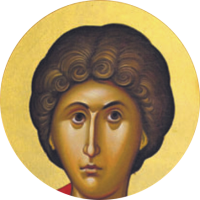
| Saint George, the truly great and glorious Martyr of Christ, was born in Cappadocia, the son of rich and God-fearing parents. His father was also from Cappadocia and suffered his own martyrdom for Christ. His mother was from Palestine. When St. George grew up, he went into the army, in which he rose, by the age of twenty, to the rank of tribune. Being a military tribune, a Commander of a thousand troops, he was illustrious in battle and highly honored for his courage. He was a leader, not only of men but of their souls. For example. when he learned that the pagan Roman emperor Diocletian was preparing a persecution of the Christians, Saint George presented himself publicly before the emperor and denounced him. He confessed the following: “I am a servant of Christ, my God, and trusting in Him, I have come among you voluntarily, to bear witness concerning the Truth.” “What is Truth?” one of the dignitaries asked, echoing the question of Pontius Pilate. The Saint replied, “Christ Himself, Whom you persecuted, is Truth. Holy George was fearless in his witness to Christ, thinking not of his own survival. When threats and promises could not move him from his steadfast confession, he was put to unheard-of tortures i.e., his feet were placed in the stocks and a heavy weight placed on his chest. After that, the emperor ordered that he be bound on a wheel, under which was a board with great nails protruding, and thus be turned. He then had him buried in a pit with only his head above the ground, and left there for three days and nights. Then, through some magician, he gave him deadly poison, but in the face of all these tortures Saint George prayed unceasingly to God, and God healed him instantly and saved him from death, to the great amazement of the people. He endured these sufferings with great bravery, overcoming them by his faith and love towards Christ. When he also raised a dead man to life by his prayers, many embraced the Christian faith. He was a sufferer in witness to the love of Christ and gave himself willingly for His Name. We who have been placed under the protection of St. George as members of the parish that proudly bears his name, ought to take concrete lessons from his life. The stories concerning St. George are both a delight and a rich part of the Orthodox tradition. For those of a practical mindset, a story that involves a princess, ravenous dragon and the knight who tames the beast insinuates a legend. What is it doing among the more sober accounts of a soldier-saint who was bold to speak the truth in a hostile environment, who died a martyr’s death, and who emboldened many others in the late third century world of Asia Minor and Rome? The liturgical texts of our Holy Church are replete with praises of St. George found in the Canon of his feast: “As the Savior’s co-sufferer, thou didst willingly imitate His death by thine own death; and now in majesty with Him thou reignest, endued with the most radiant purple robe wrought of thine own sacred blood, and adorned with the scepter of thy martyric deeds; and the crown of thy triumphs doth enhance thee unto ages everlasting, O thou all-lauded Great Martyr George.” And again: “As one valiant in martyrdom, trophy-bearer, Great Martyr George, on this day we gather to chant thee hymns of praise; for thou hast finished the course and hast invincibly kept the Faith, and from God thou hast received thy great victory’s crown of light; hence entreat the Lord to deliver from perils and corruption them that faithfully do honor thine ever-venerable memory.” Why does the Holy Church venerate this soldier-Martyr? Why is he patron of countless cities and organizations throughout the world, patron of more than 200 national churches? St. George is the trophy-bearer, or victory-bearer, because of his steadfastness in obeying God, rather than idolatrous man. To a scoffing pagan judge who asked, “What is Truth?” Holy George proclaimed Jesus Christ himself as the Living Truth—not simply a religious system or a philosophy. This aspect of his story assures us that the Saint knew the Lord intimately, and that his resolve not to capitulate was based not only on principle, but on inner knowledge, on inner conviction, on the wisdom of the Holy Spirit. He bears the victory because he bore the suffering along with Jesus. Holy George suffered. The holy, Great Martyr George, calls each of us in our parish to imitate his conviction. He calls us not to be ashamed of the Gospel, but to boldly witness it to others and to the world, by what we say and how we act. Losing our assertive ego and self-will is certainly not the worst thing that can happen to us. Losing the life of our soul, losing closeness to God, most certainly is. In the legend of the killing of the dragon, the Saint reminds us of our call to identify and fight evil – no matter how pervasive or persistent it is. Blending in with the “attractive” wooing of society to adopt its values, shallow lifestyles, and questionable moral and ethical attitudes that will ultimately imperil our hearts and souls is a path St. George could never take. He was ever-mindful in his heart of the Lord’s declaration “My Kingdom is not of this world…”(John 18:36) The truth of this world is not the Truth of Christ who said: “I am the way, the truth, and the life…” (John 14:6) St. George was martyred and thus spilled his very blood for the sake of Jesus the Christ of God. While we may consider martyrdom an impossibility, at the very least a remote chance for ourselves these days, his holy life and death teach us a critical lesson. The Saint’s life story leads us to see the deeper truth, the more profound truth of living which is beyond this world but also deeply affects it. We await the final judgment, the time when that “accuser”, the evil one, will be completely removed from our scene, and when there will be a “new heaven and new earth,” and all the former sorrows will be gone! To achieve this new world, in the spirit of Holy George, you and I must be bold about living our Holy Orthodoxy – bold not comfortable, determined not placid. We must take it out of whatever “closet” into which we have tucked our faith and witness it to the broken world, live it, nurture it in and through the Divine Services, religious educational programs and the ministries of this parish. Not to do this is to reduce our Orthodox faith to a mere ornament in our lives. Baptism does not begin an automatic process until the day we die. It must be actively lived and witnessed every day. It must be reflected in what we do with our time and energy daily. It must take seriously the words of the Lord: “Therefore everyone who confesses Me before men, I will confess him before my Father in Heaven. But whoever denies me before men, I will deny him before my Father in Heaven.” (Matthew 10:32) Silence can be construed as denial. Hiding one’s faith “under a bushel basket” can be construed as denial. To take the challenge of the boldness of the Great Martyr and Trophy-Bearer George to heart and to live it, makes our Orthodox faith a living and bold reality, a seen entity, a heard proclamation, and a signpost to all others who search for a fulfilled human heart: This is the Way to God, This is the way to inner peace, This is the path to the light of hope in a world of growing darkness and fear! O Holy Great Martyr and Trophy-Bearer George, we give you praise and ask that you continue to pray before the face of God, for this holy parish that bears your name, and for every person in it! A blessed feast day to each of you! I am faithfully in the Lord, |