Click here for the October 28, 2018 Bulletin
A GREAT CLOUD OF WITNESSES
We commemorate this Sunday the Protection of our Most Sovereign Lady, the Holy Theotokos and Ever-Virgin Mary. In a reflection at the beginning of October, we considered the event that caused this yearly commemoration, the appearance of the Theotokos to St. Andrew the Fool-for-Christ and St. Epiphanios, in the Church of Blachernae’s palace, in defense of the Christians and of the city which were under invasion and persecution by pagan hoards. While her faithful protection was symbolized in the holding of her veil in her hands over the people and the city, she was and is, nonetheless, a Saint. She is not God and she is not worshiped as such. The late theologian, Fr. Thomas Hopko (+2015), of Blessed Memory, wrote: “The mother of God is venerated and honored because of her Son and never apart from Him. She is the Panagia, the first and fullest of the Saints, leading the Church in a continuous intercession to the Trinity.” (Sermon on All Saints) Since Jesus Christ is the “one mediator between God and Man,” (I Tim. 2:5), Mary is an intercessor whom we ask to pray for us. This raises the question of the Saints and of their place in the prayer life of the Church and of every Orthodox Christian.
While most of the Reformation churches of Protestantism, in the main, regard Saints as “unbiblical” (their ultimate test for authentic religious practice), therefore praying to them is unnecessary and, in the extreme, an offensive act against Christian faith. God, they reason, can be prayed to directly and needs no intermediaries. The Holy Orthodox Church (along with the Roman Church) have a decidedly different approach to the Saints. The Epistle to the Hebrews (11:32-12:2) speaks of the God-fearing Christian men and women who were tortured, suffered mocking and scourging, chains and imprisonment, stoning, being stabbed to death, left destitute, afflicted and ill-treated, and goes on to say “Therefore, since we are surrounded by so great a cloud of witnesses (μ?ρτυρες), let us also lay aside every weight and sin which clings so closely and let us run with perseverance the race that is set before us.” (Heb. 12:1) St. Paul wrote to the Romans: “To all God’s beloved in Rome, who are called to be saints…(Rom. 1:7) To the Corinthians he wrote: “To the church of God which is at Corinth, to those sanctified in Christ Jesus, called to be saints” (I Cor. 1:2) The call to sainthood is directed to us. How is it that the Saints figure into our prayer life?
St. Paul was not writing to people likely to figure in stained-glass windows, but to a motley collection of shop-keepers, minor civil servants, converted prostitutes, prizefighters, slaves, fishermen – not the spiritual elite but the weak, not the perfect but the wayward, not those honestly proud of what they had become but those who wished with all their heart that they could be and do and think like Jesus did. Unaware to them, they desired to become Saints. Some were officially recognized as such, untold others achieved the dignity from God and were unknown to the Church by name. St. John of Kronstadt teaches us that we on earth (Church Militant) are in constant communication with these sainted ones (Church Triumphant): “We live together with them in the house of the Heavenly Father”, he wrote, “only in different parts of it. We live in the earthly, they in the heavenly half; but we can converse with them and they with us.” This truth is known as the Communion of Saints. Death does not stop the interaction, it does not silence it. Those who have reposed and have tried their level-best to do the work of Christian asceticism, are still within reach of our prayers, and we theirs. The love they showed us while on earth persists for us, every bit as much as when one stand at the grave of a parent, or child, or relative or friend and tears well up, the heart labors to beat, the tears create furrows down one’s cheeks. In that moment, you are joined to the one you love by the power of the Risen Lord and you are together once again.
This Communion of Saints is exemplified in a story from Mt. Athos. A pilgrim visited the Holy Monastery of Dionysiou. He wrote: “They Church had its own air of mystery. A few red lamps burned before the golden iconostasis and the icons on the stands. Hieratic saints solemnly looked down from the blue walls. It seemed as though, they too, had come to assist at the Liturgy. Noticing the small congregation, the cynical pilgrim said to the priest-monk “Not many in Church this morning, not many at all” The monk replied: “You are wrong my son. There were thousands at Church and tens of thousands. For the priest had just read the prayers of the Liturgy: “Therefore with Angels and Archangels and all the company of heaven we praise and magnify Thy glorious Name, evermore praising Thee!” The Saints were there!
Professor David McCarthy, of the University of Notre Dame, encapsulates this experience: “The Saints and their lives embody an Incarnational reality (Word-made-flesh); they populate the borderlands between the future and now, between there and here, between heaven and earth. They bring ordinary life and its people into a genuine experience of community – oneness with them.” (A Theology of the Communion of Saints) This is why Orthodox Christians reverence and venerate the Saints and their relics, because the body along with the soul is redeemed and sanctified; one day it will rise from the grave to be with God forever. Such a relationship can only be described as “intimate” and in the memory of the Saints we feel God come closer.
Archimandrite Theofilos (Lemontzis) of Mt. Athos reminds us that “The lives of the saints are permeated with this militant and heroic spirit. As sharers in the Holy Spirit, they fear nothing, not death, not deprivation, not poverty, not the devil: ‘For those who are led by the Spirit of God are the children of God. The Spirit you received does not make you slaves, so that you live in fear again.” (Rom. 8, 14-15) The saints are the protoypes of people who progress from self-interest to impartiality, from dependence to autonomy. Mary, the Theotokos, and all the other Saints of God, named and unknown to us, have run the race and kept the faith. They have not vanished, nor left us, nor abandoned us to figure out our path to holiness by ourselves. We live in communion with them and have their lives, words, and examples of how to be God-centered and Christ-centered, and above all, less ego-centered — always open to the Holy Spirit’s power to transform us, olyH to move us up the ladder of Divine Ascent (theosis) — ever-closer to the Throne of Grace, ever nearer to that moment when we can say with the hymnographer — “It is well, it is well with my soul!”
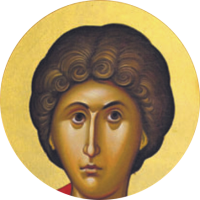
The saints are truly free. There are innumerable examples of our saints who achieved this level and acquired real freedom from the fear of death, from the cares of life, the wickedness of the devil and, simultaneously, acquired the mortification of the self through unselfish love for others. Pray to the Mother of God and to the Saints, read their lives and their teachings, bring their icons into your icon corner as visual reminders that where they have trod, we too shall follow. As we pray to the Most Holy Theotokos for protection this day, let us commend ourselves, one another, and our entire life to Christ our God and to those Saints through whom He revealed His face to us! Amen.
Your faithful servant,
Fr. Dimitrios