Click here for the October 14, 2018 Bulletin
SOMETHING WORTH FIGHTING FOR…. |
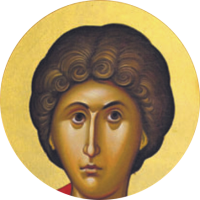
| The year is 787 AD and the Holy Orthodox Church is facing another crisis. Amid the attacks of those for whom the holy icons were not holy but were, rather, symbols of a latent Old Testament idolatry, the new “Golden Calf” of the Christian first century, the 350 holy Fathers assembled had enough and gathered at Nicea once again, this time to defend and proclaim the rightness and sanctity of the divine images. It would come to be known as the Seventh Ecumenical Council and we commemorate it this coming Sunday. Riding point in the theological battle was St. John of Damascus whose three works entitled “Apologetic Treatises against those Decrying the Holy Images” were among his earliest expositions in response to the edict by the prominent iconoclast Emperor Leo the Isaurian of Constantinople, which banned the worship or exhibition of holy images. The Damascene would write: “Concerning the charge of idolatry: Icons are not idols but symbols, therefore when an Orthodox venerates an icon, he is not guilty of idolatry. He is not worshipping the symbol, but merely venerating it. Such veneration is not directed toward wood, or paint or stone, but towards the person depicted. Therefore relative honor is shown to material objects (προσκ?νησις), but worship is due to God alone (λατρε?α).” Through the icon, just as through Holy Scripture, we not only learn about God, but we come to know God, to experience his “energies.” Through the holy icons of the God-pleasers we touch transfigured man, transformed man, a partaker of Divine life; through the icon we receive the all-sanctifying grace of the Holy Spirit. This is why of all the victories over a multitude of heresies, of all the other Ecumenical Councils of the Church, only the victory over iconoclasm and the restoration of icon-veneration was proclaimed to be the Triumph of Orthodoxy! What does a seemingly obscure and distant Council mean for our Orthodox faith and life today? Moreover, how ought we to understand the place that the holy icons play in our attempt to walk the ascetic way (θ?ωσις) and to fight the “unseen warfare.” They hang in our homes, perhaps our cars, and amazingly we often pay little attention to them. A contemporary Elder of the Church, Archimandrite John Krestiankin (+2000), expresses it soberly: “We hold icons in our hands and keep them on the walls of our houses, but do not remember that the Holy Spirit is looking for living and inspired temples worthy of the inhabitation of holiness in the owners of icons; and not finding such, He will withdraw, and then will be pronounced over them the sober words: “There is none that understands, there is none that seek after God. They are all gone astray, they are together become unprofitable.” (Romans 3:11-12) The Elder’s point? There must be a living and direct connection between the images that hang in our churches and homes, and the kind of life we lead as professed disciples of the Eternal Icon of the Living God – Jesus, the Christ. The icon speaks to us of God (θεολογ?α), it speaks to us of who we are and can be as human persons (ανθρωπολογ?α), and it has its source and summit, in holy worship — the Divine Liturgy (δοξολογ?α). The world-renowned iconographer, Archimandrite Theodore (Zenon), in a lecture in Vienna said: “The icon does not represent anything, it rather reveals something. In the first place it reveals the invisible God to us – God Who, according to the Evangelist John, “no one has ever seen” but who was revealed to humankind in the person of the God-Man Jesus Christ.” (John 1:18) Every icon, be it hand-written, or made of paper, or a mosaic, by whatever material, is a point of contact with God. Each icon is theological. It is not primarily art, it is the “expression of depth”, a window on eternity, a glimpse of the “glory” of which St. John the Theologian wrote in the Prologue to his Gospel: “And the Word became flesh and dwelt among us, full of grace and truth, we have beheld his glory, the glory as of the only Son from the Father.” (John 1:14) The icon is, therefore, Incarnational – it is God expressed and exposed in material form, in the matter of Creation, in the creation of human hands, in the paradigmatic creation of the Word-Made-Flesh, Jesus of Nazareth. Because icons are sacramental in nature, they ought to be treated with reverence, never hung like one would hang secular art, and preferably placed in the icon corner, the spiritual center of every Orthodox home. The first Greek Orthodox iconographer in the United States, Theodore Tsavalas, who went blind as he neared the end of a life of writing icons, once said: “If you have an icon you have a sacred object, do not forget about it. Turn your gaze to it daily, let us stand in silence before it, clinging to it with our soul.” God is there…spend time with Him! Each icon is anthropological – it expresses the true nature of the human person. It expresses YOUR nature and destiny. Dr. Daniel Munteanu, a professor of Orthodox Theology at Valahia University in Romania, expresses it this way: “Human beings are icons of God, partakers of God’s grace, clothed with beauty, and can become a living doxology, a window to the beautiful grace of God, a transparency towards Divine holiness.” The written icons show the image as transformed by God, fundamentally changed. This is expressed by, for example, thinner hands and feet than In real life, the nose, eyes, and ears are more oblong, the head is usually smaller. The mouth is small and the eyes are larger and form the center of the icon. These are artistic ways of revealing that the person has changed by the Holy Spirit, been altered by their struggle to become holy – to be by grace what God is by His nature. Icons ought to remind us of that process in our own lives. As the iconographer, St. Andrei Rublev taught: “The most important thing in an icon is the joy of the definitive victory of the God-Man over the bestial man and the bringing of all humanity and all creatures into the Church.” An icon shows not so much a process as a result (holiness), not so much a way as a destination, not so much a movement towards a goal but as a goal in itself. How goes your journey to holiness? Can you use your icons to help you find the way? Each icon is doxological – it comes from and leads to Divine worship (prayer). The Hieromonk Gabriel (Bunge), a hermit and renowned Swiss theologian and Patristics scholar, frames this aspect of the icon: “The icon’s theological place is primarily the Liturgy in which the message of the Word is complimented by the meaning of the icon. Outside of the Church and the liturgy, the icon largely loses its meaning. While Christians are encouraged to hang icons in their home, they do so only insofar as the home is a continuation of the Church and their lives are a continuation of the Liturgy.” Every icon grows from prayer, it embodies prayer, it is created in prayer for prayer. Its driving force is the love of God and yearning for Him as perfect Beauty. Metropolitan Hilarion (Alfayev) writes: “As the fruit of prayer, the icon is a school of prayer for those who contemplate it and pray before it. By its entire spiritual structure, the icon disposes one to prayer, at the same time taking us beyond the icon and placing us before the very prototype – the Lord Jesus Christ, the Holy Theotokos, or a saint.” Is your home a continuation (extension) of the Church? Is your daily life a continuation (extension) of the Divine Liturgy? Use your icons. Center them in an icon corner to establish the spiritual center of your home. More than 1,200 years ago, the Church struggled for the icon. In our time, it is the icon that struggles for the Church. It struggles for Orthodoxy, truth and beauty. Ultimately, it struggles for the human soul because it is the soul’s salvation in which the Church’s and our personal reason for existence lies. Spend time in prayer before your icons everyday. See God, see yourself as you are meant to be, see in that imperfect image a window on eternity.Faithfully your servant, Fr. Dimitrios |